Conjunction (Basic ㊦ 488)
A conjunction that lists two or more items, actions or states as inexhaustive examples.
Equivalent: And; or
| (i) Noun | とか Noun とか… | |
| 学生とか先生とか… | Students and teachers… (among others) | |
| (ii) Sinformal | とか Sinformal とかする | |
| テレビを見るとか本を読むとかする | Do such things as watching TV or reading books |
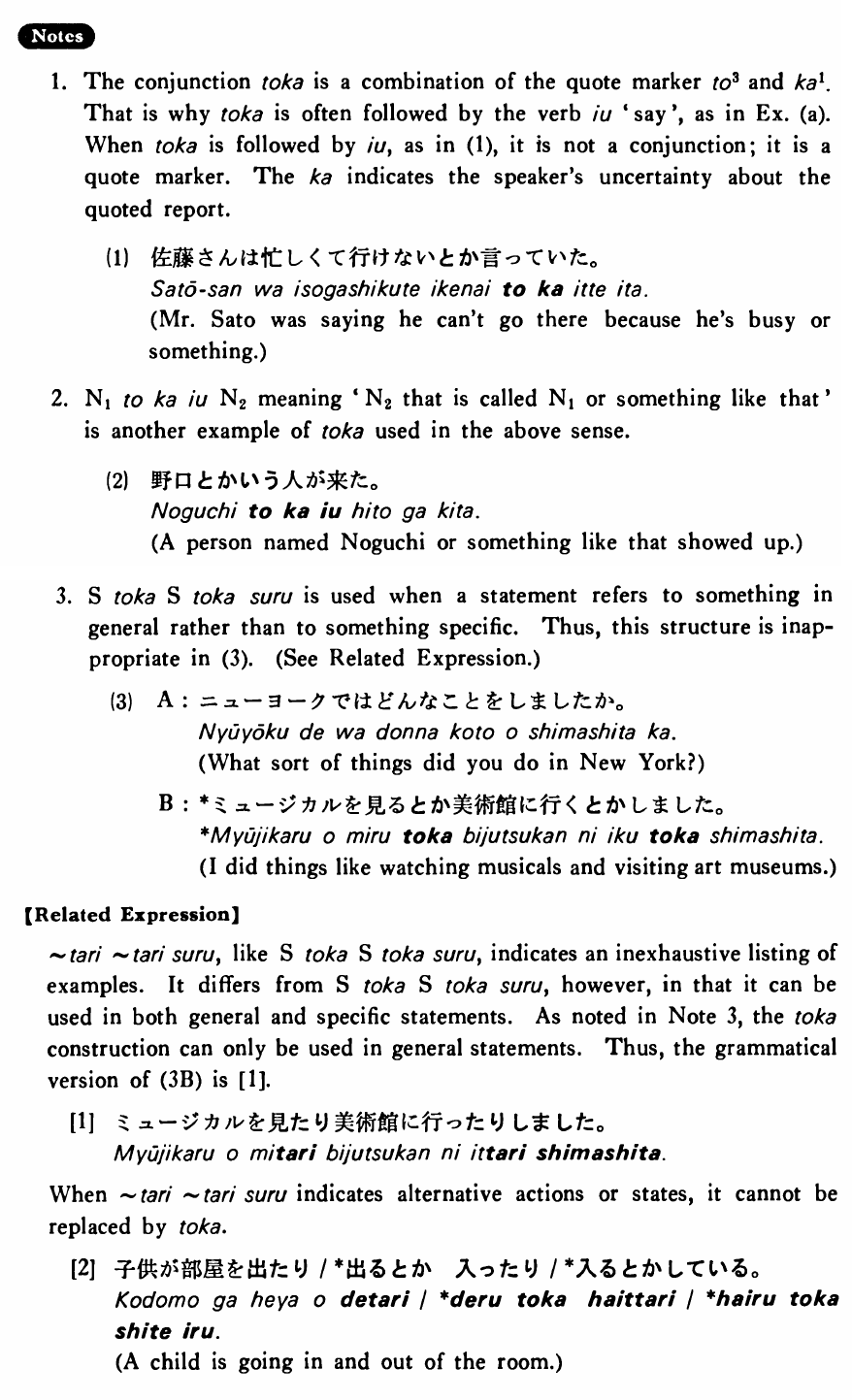
1. The conjunction とか is a combination of the quote marker と3 and か1. That is why とか is often followed by the verb 言う 'say', as in Example (a). When とか is followed by 言う, as in (1), it is not a conjunction; it is a quote marker. The か indicates the speaker's uncertainty about the quoted report.
2. Noun1とか言うNoun2 meaning 'Noun2 that is called Noun1' is another example of とか used in the above sense.
3. SentenceとかSentenceとかする is used when a statement refers to something in general rather than to something specific. Thus, this structure is inappropriate in (3).
(See Related Expression.)
【Related Expression】
たり~たりする, like SentenceとかSentenceとかする, indicates an inexhaustive listing of examples. It differs from SentenceとかSentenceとかする, however, in that it can be used in both general and specific statements. As noted in Note 3, the とか construction can only be used in general statements. Thus, the grammatical version of (3B) is [1].
[1]
When たり~たりする indicates alternative actions or states, it cannot be replaced by とか.
[2]